
On Kauaʻi you can taste chocolate where the cacao grows and buy fruit from the farmer who picked it. The farms here grow coffee, cacao, taro, vanilla, and pineapple. Many run tours. Guided food tours come from Tasting Kauaʻi and Ono Kauaʻi Food Tours, and farmers markets run in Kīlauea and Līhuʻe.
This guide is for travelers who would rather build a day around a farm and a market than eat every meal at the resort. Start at Kauaʻi Coffee Company, the largest coffee plantation in the state. Its free self-guided walk includes tastings. Markets run on different days, so check the schedule before you go and end the afternoon at a food truck with a box of poke.
Table of contents
- Farmers markets
- Farm tours
- Food tours + Cooking classes
- Local foods (and where to try them)
Below is a rundown of our preferred farmers markets, farm tours, food tours, and the local dishes worth seeking out.
Related: Culinary activities on Maui, Oʻahu and the Big Island
Are you planning to also visit other islands in the state and do you like our style? Then the following guides might be a good place to start your culinary trip planning:
- Culinary tours and activities on Maui
- Culinary tours and activities on Oʻahu
- List of farm tours on the Big Island
Farmers Markets
A farmers market is the quickest way to taste what Kauaʻi grows: tropical fruit and produce you won’t find in a mainland grocery store, sold by the people who raised it. It’s also where locals shop, so a morning at the stalls shows you what people here cook and eat. Markets run on different days around the island, so there’s almost always one open somewhere.
Here are 3 popular farmers markets on Kauaʻi. For a more complete list, see the one put together by Tasting Kauaʻi.
Kalalea Anahola Farmers Market (Sunday)
- Where: 4541 Hokualele Road, Anahola, Sunday, 10:00 am – 2:00 pm
- What to Expect: Farmers from Kalalea and Anahola sell their fresh produce alongside plate lunches, shave ice, and other local products.
- Website: Kalalea Anahola Farmers Market
Grove Farm Market (Saturday)
- Where: Puhi Park, Līhuʻe (next to Kauaʻi Community College), Saturday 9:30 am to noon
- What to Expect: Farmers from across Kauaʻi sell fresh produce. Also: Special food demos, guest presentations, and tours of the KCC organic farm.
- Website: Grove Farm Market
Anaina Hou Farmers Market (Saturday & Sunday)
- Where: 5-2723 Kuhio Highway, Kīlauea; Saturday 9:00 a.m. – 1:00 p.m., Sunday 10:00 a.m. – 2:00 p.m.
- What to Expect: Organic, fresh produce from farms across the island.
- Website: Anaina Hou Farmers Market
Farm Tours
Many Kauaʻi farms are open to visitors, and a morning at one shows you where your food starts. You can watch how dragon fruit grows or how coffee gets from cherry to cup, then meet the family running the place. The farms below cover taro, pineapple, coffee, cacao, tea, vanilla, and goat cheese.
Taro Farm Tours
The pineapple, coffee, and chocolate tours below draw bigger crowds, but the taro farm has the longest history. Taro fed Hawaiʻi for centuries and is still the base of dishes like poi and laulau. If you care more about history and culture than novelty, start here.
- Hanalei Taro (website)
Good to know: The Haraguchi Rice Mill, the family operation behind the guided taro farm tours here, has paused tours while it recovers from 2021 flood damage. Check their site before you plan a visit around one.
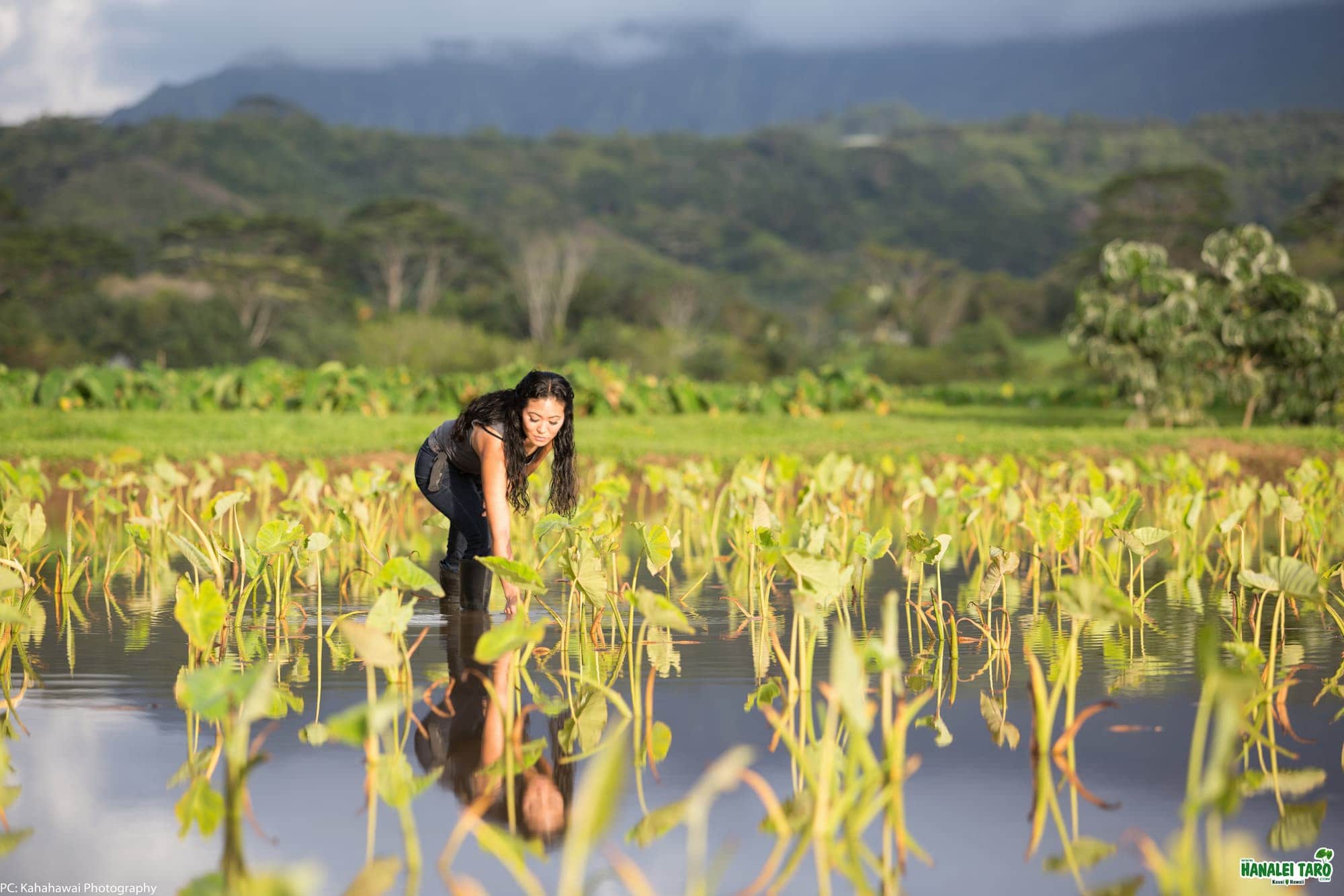
As co-owner of Hanalei Taro Lyndsey is the perfect person to lead the taro farm tours. Image credit: The Haraguchi Rice Mill website.
Pineapple Plantation
Pineapple is not native to Hawaiʻi, but it became the crop most associated with the islands. Kauaʻi was never a major pineapple producer the way Maui, Oʻahu, and Lānaʻi were, but one farm here still grows it and runs tours covering the fruit’s plantation history.
- Sugarloaf Pineapple (website)
Coffee Farms
Coffee is one of Hawaiʻi’s signature crops, and the Kona coffee region on the Big Island is the best-known. But coffee grows on every island, and each area produces its own distinct flavor.
Kauaʻi has the state’s largest coffee plantation, Kauaʻi Coffee Company, which runs a free self-guided walking tour with tastings through the day.
- Kauaʻi Coffee Company (website)
Chocolate Orchards
Hawaiʻi is the only US state where cacao, the bean chocolate is made from, grows commercially, and several Kauaʻi farms turn their own harvest into chocolate on site. On a tour you follow the process from cacao pod to finished bar, usually with plenty of tasting along the way.
- Lydgate Farms (website for tickets)
- Garden Island Chocolate (website)
- Wild Chocolate Kauaʻi (website)
Tea, Vanilla, and Goat Cheese Farms
Beyond the big crops, a handful of small, family-run Kauaʻi farms grow tea, vanilla, and goat cheese and open for tours. These visits are more personal than the coffee or chocolate operations: you see how one family works its land and makes its single specialty.
- Kauaʻi Farmacy Tea Tasting (website)
- Vanillery Farm Tour (website)
- Kauaʻi Kunana Dairy (website)
- Haraguchi Rice Mill (website)
Food Tours
A food tour packs several of the island’s kitchens into one outing, with a guide who knows which stops are worth saving room for. You taste a lot of a region’s food in a couple of hours and learn which restaurants and purveyors to come back to.
Most Kauaʻi food tours are walking tours built around one region, the east side or the south shore rather than a single cuisine, so you burn off one stop on the way to the next.
Tasting Kauaʻi runs a different region each day of the week, a flat $114 per person for a 2.5 to 3 hour walk with several tasting stops. Ono Kauaʻi Food Tours sticks to Hanalei on the north shore, closer to $99 for a 1.5 hour walk.
- Tasting Kauaʻi: The most comprehensive food tour company with a variety of offerings throughout the island’s different regions (website)
- Ono Food Tours: North shore only, focused on restaurants of Hanalei (website)
Local Foods to Try (and Where to Find Them)
Some of the best eating on Kauaʻi is the everyday local food, the plate-lunch and mixed-plate staples you see all over the island.
Saimin
Translating from Chinese to mean “thin noodle,” Saimin is usually served as a soup with dashi broth and thin noodles made from wheat and egg. The noodles are made fresh in the islands and the dish can be topped with green onions, meat, seafood, or eggs. The Saimin noodle dish is special because it originated in Hawaiʻi during the plantation days and is a unique Hawaiian culinary experience here today.
Recommended restaurants:
- Hamura Saimin (Līhuʻe)
- Wailua Drive In (formerly Saimin Dojo, Kapaʻa)
Learn more about Saimin in the following video (spoiler: Saimin is life!)
Kalua Pork
Kalua pork is the Hawaiian version of pulled pork. In traditional times, the pig was cooked in an imu, or underground oven, using hot rocks and banana leaves. The pork is slow-cooked with salt, allowing it to stay moist. It is not usually served with any sauce, although some places add barbecue sauce when serving it as a sandwich.
If you’re going to a lūʻau, you will definitely have the chance to try kalua pork. Otherwise, try these fine establishments on Kauaʻi:
Recommended restaurants:
- Mark’s Place (Līhuʻe);
- Trucking Delicious (Hanalei);
- Pono Market (Kapaʻa)
- Kōloa Fish Market (Kōloa)
Good to know: If you don’t have the patience to cook Kalua Pork the traditional way you can also make it in a pressure cooker!

Poi
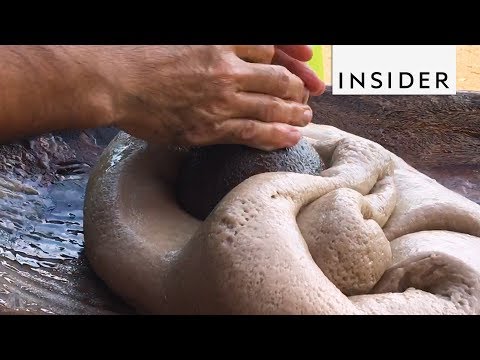
Poi is one of the most important foods of ancient Hawaiʻi and still turns up on tables today, though convincing visitors to eat it has never been easy. It’s taro, pounded into a paste of varying consistency, sometimes bland, other times tangy or even sour. It usually comes as a side dish alongside fish or pork, and many Hawaiʻi farms sell it by the pound.
Give it a try. It goes well with salty or sweet dishes, like kalua pork or certain kinds of poke.
Recommended establishments:
- Hanalei Poi (Hanalei)
- Hanalei Taro (Hanalei)
- Aloha Aina Poi Mill (Waimea)
Curious about Poi? Learn more about it in the following video:
Poke
Poke is one of the most popular local dishes in Hawaiʻi, and its fame has spread, with poke shops opening across the mainland and even Europe. It’s best eaten fresh at the source, though. Poke is cubed, marinated, sushi-grade fish, eaten over rice as a poke bowl or on its own (we like a toothpick).
There are endless poke options on every island, but here are a few to target on Kauaʻi:
Recommended restaurants:
- Pono Market (Kapaʻa)
- Konohiki Seafood (Līhuʻe)
- Kōloa Fish Market (Kōloa)
- Hanalei Poke (Hanalei)
- Ishihara Market (Waimea)
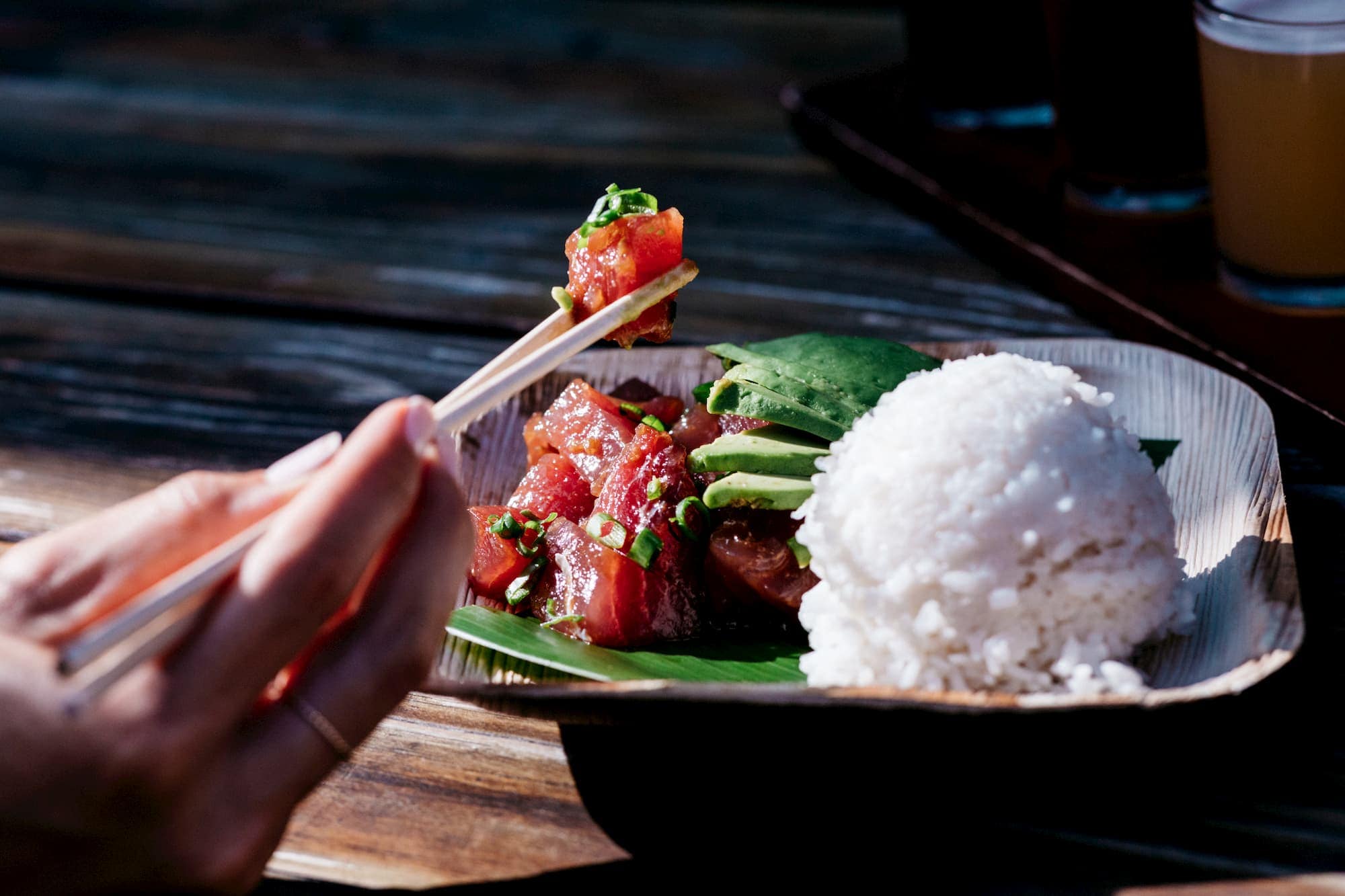
Poke is raw fish marinated with soy sauce, onions and lemon, though many other combinations exist. Pictured here is a bowl of Ahi (tuna) poke with green onions and avocado. Image credit: Hawaiʻi Tourism Authority (HTA) / Ben Ono
Laulau
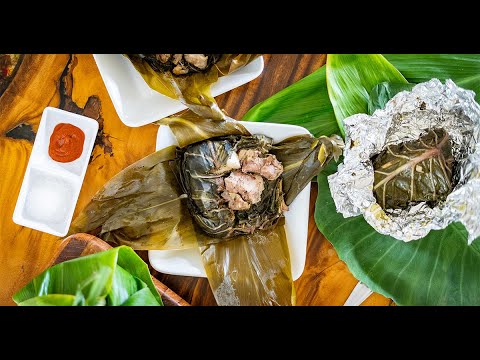
Laulau is a traditional Hawaiian dish of meat, fish, or vegetables wrapped and steamed in a taro leaf, which cooks down to something close to spinach in taste and texture. It was a convenient meal for ancient Hawaiians, who could wrap up whatever they had and steam it in an underground oven.
Recommended restaurants:
- Hanalei Taro & Juice (Hanalei)
- Pono Market (Kapaʻa)
- Konohiki Seafood (Līhuʻe)
Want to make Laulau yourself? Check out the following video:
Shave Ice
A great treat to beat the heat! You’ll see this dessert/snack spelled two ways (Shave Ice and Shaved Ice), and though no one really knows which one is correct, everyone knows not to call it a snow cone. Either way, it’s finely chopped/shaved ice with sweet syrup poured over top. The syrup is sometimes artificial (sugar-based) and other times made from fresh fruit.
Recommended restaurants:
- Wailua Shave Ice (Wailua)
- Jo Jo’s Shave Ice (Various locations)
- Ono Family Restaurant (Kapaʻa)
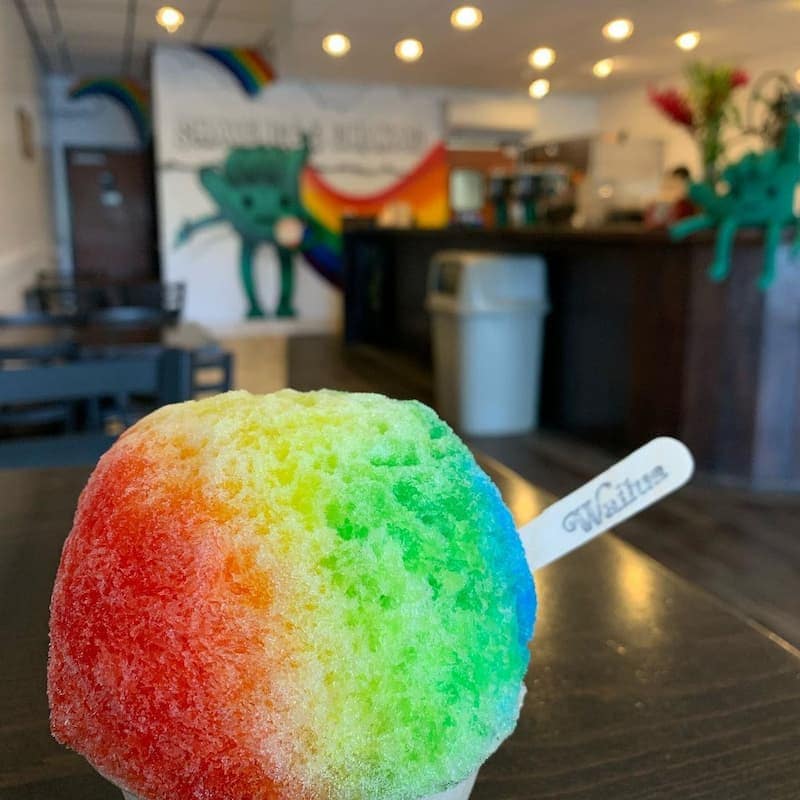
The rainbow is one of the specialties at Wailua Shave Ice.